Following on from Part 1 we continue to examine the significant damage a seemingly harmless nickname can do to a case and its victims.
Specifically:
- What a moniker does for public perception
- How the moniker was responsible for deaths
- Effects on family and ongoing repercussions
What a moniker does for public perception
Just for a moment, put yourself in the shoes of the 1970’s Yorkshire public, and consider the nickname carefully. Imagine you had no idea what this man looked like, and try to visualise an image worthy of that particular moniker.
I’m guessing most of you didn’t imagine a smaller-than-average, thin, unassuming bloke-next-door, with a high-pitched voice. And that’s the problem, right there. Monikers create an image: a visual which is usually so far removed from reality, that the police lose sight of who they are actually looking for, and the public don’t know who they need to be wary of.
Constant media references to monsters and ogres serve only to distort our view of who the killer really is: essentially shielding them from capture and allowing further loss of life. There were so many people (family, friends, colleagues and even police) in contact with Sutcliffe during his time as a killer, yet none of them suspected him. Why? Because the image being sold to them was nothing like the man they knew or the man standing in front of them. The moniker allowed Sutcliffe to go about his business unsuspected.
Interestingly, after Sutcliffe’s capture in 1981, The Daily Mail wrote:
This short, slight, dark-eyed man fitted no picture drawn up by artists, nor any image conjured up by the minds of detectives.
I’ll start by pointing out that it’s what the quote doesn’t say that speaks volumes to me, i.e., that the press themselves were responsible for creating the fantasy visuals by giving him the moniker in the first place. What’s more, the opening clause of the sentence is completely untrue: “This short, slight, dark-eyed man fitted no picture drawn up by artists…” Reader, I give you this, from Michael Bilton’s Wicked Beyond Belief:

With the exception of the final two images, which are of Peter Sutcliffe himself, what you are looking at are the 29 photofit images drawn up with the help of victims and eye-witnesses over the course of Sutcliffe’s active years. To my mind, 24 of them resemble each other, which gives credence to their accuracy. Of those, 11 are dead ringers for Sutcliffe, in terms of similar features and facial hair. For clarity, these are the exact same photofits that DS Jim Hobson saw fit to withhold from his colleagues as mentioned in Case Notes (see Point 5. The photofit farce). So, what do you think the difference in outcome might have been, if these images had been circulated at the time? Instead of looking for a mythical, non-existent monster, is it not more likely that both the police AND the public would have been on the lookout for a normal man, with dark hair, a beard and moustache? I think so.
Monikers don’t just skew the public’s perception, they skew EVERYONE’S perception. No-one was looking for Sutcliffe.
How the moniker was responsible for deaths
We’ve already explored how a moniker can throw people off the scent of the real killer, which no doubt results in the slowing down of progress on a case. However, in the case of Peter Sutcliffe, there was a much more obvious distraction caused by the moniker, which literally took police in the wrong direction, whilst all the time allowing Sutcliffe to continue killing women undetected.
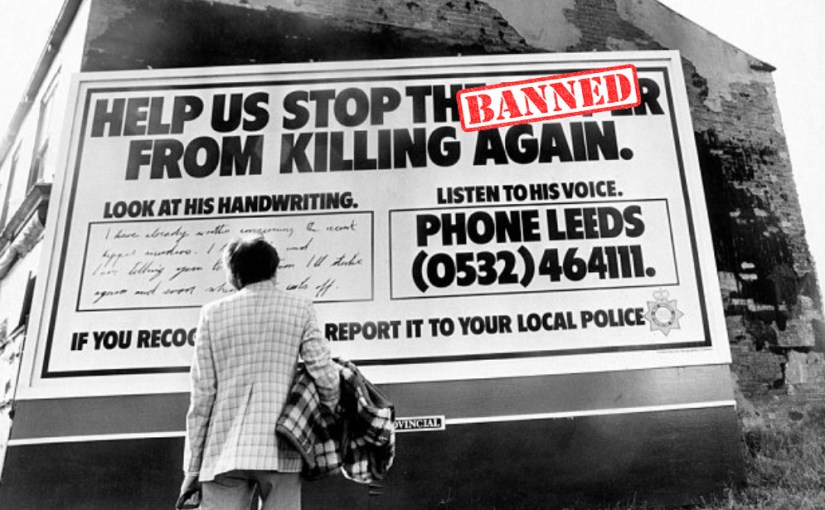
As mentioned in Point 7 on the Case Notes page, a hoaxer saw fit to play mind games with the then leading officer on the case, ACC George Oldfield. Through 1978 and 1979, Oldfield received a total of three letters and one recorded message, from someone claiming to be the killer. The recording revealed a man with a Geordie accent, and the letters were handwritten, and signed ‘Jack the R’.
From the moment the first letter was received, the case became personal for Oldfield, who was convinced that the killer was communicating directly with him. Despite opposing views from a number of colleagues and linguistic experts, Oldfield was adamant this was his man, and refused to follow any other line of inquiry. From here on, he would be looking only at men from the North East of England, who had the same handwriting as the author of the letters. A major PR campaign, costing around £2 million (unprecedented for the time) was launched nationwide. Already-flagging resources and manpower were exhausted further in the taking of handwriting samples and the trawling of bars, shops, town centres and housing estates, playing the recording on loudspeaker to see if the voice rang bells with the public. Of course, no evidence was forthcoming.
But how does all this make the moniker responsible for more deaths? Well, without it, the hoaxer would not have made that link between the current killer and Jack, the 1880’s killer of prostitutes. I know it could be argued that if he hadn’t used that as the basis for his lethal practical joke, he would very likely have found something else, but the reality is, we’ll never know. As it stands, because of the moniker, he made the link, and wrote the letters. In a strange obsessive twist, the hoaxer had not only signed himself off as ‘Jack the R’, but had also used phrases and language found in Jack’s original letters written to police back in the 1880s. The link to the moniker was real.
So, while all this was going on, Sutcliffe was, in effect, scot-free. After the first hoax letter, which was received by police in March 1978, he attacked Ann Rooney, Dr Upadhya Bandara and Teresa Sykes – who all survived their attacks. Sadly, Vera Millward, Josephine Whitaker, Barbara Leach, Marguerite Walls and Jacqueline Hills, did not. Eight attacks resulting in five deaths – could they have all been avoided had the police been looking in Yorkshire, and not the North East? Again, we’ll never know, but obviously, the chances of his capture would have been a lot higher.
I’ll finish by saying this: I explained in Part 1 how a moniker can absolve a killer of responsibility. So with that said, in considering the facts, we must be careful not to diminish Sutcliffe’s sole culpability by incriminating others. Neither the author of those letters, nor any member of the police force, laid hands on those women – and when Sutcliffe accused the hoaxer of having ‘blood on his hands’, we need to see that for what it was: yet another diversion tactic. But, whilst never losing sight of the fact that the murders were entirely Sutcliffe’s own work, we can still acknowledge that the moniker was most definitely his friend.
Effects on family and ongoing repercussions
At the time of The Long Shadow airing on ITV, Richard McCann, son of Wilma McCann, appeared on a number of TV interviews. In them he was asked about the name of the show, and explained that he and other victims’ family members had agreed to endorse the show only if the moniker was not used in its title. He went on to explain why, and his explanation was simple:
It’s a triggering word, if you think about what the word is trying to describe. So for the family members, it reminds us of the horror of what he did to the women.
Graciously, ITV agreed, but sadly not all producers have the same levels of decency. In a recent 4-part drama on a global streaming service, family members were told the title of the production was going to be ‘Once upon a time in Yorkshire‘, and for that reason they agreed to take part. At the last minute, and with no consultation with the families, the title was changed. The show’s promo packshot is the featured image at the top of the blog – it’s neither classy, nor original.
So what compels people to continue using the moniker, especially when they’ve been asked not to? I think there are a number of explanations (none of which are justified when you consider we’re talking about fully grown adults here, who should really be able to apply some thought and consideration to such a sensitive subject).
Firstly, there’s the obvious. It’s glamorous, intriguing, likely to draw an audience. In short, it sells. Crude, but true.
Second is something I think we can all relate to, although some of us are more inclined than others to check our own behaviour once something has been pointed out to us as triggering. I think the problem is this: the moniker is just so familiar to us now, that we don’t even ‘hear’ it or consciously think about what it actually means. Chatting to a friend about this, I used band names as an analogy. When we think about The Beatles or Elbow for example, we think immediately of the bands. Images of big black insects, or actual elbows don’t even figure in our thought process. The moniker has suffered the same fate: its literal meaning has been diminished by our over-familiarity with it, but as I previously suggested, those of us with compassion, empathy and common decency wouldn’t dream of using it, following a plea from the victims’ family members. If one of your loved ones was killed in that way, would you want constantly reminding of the graphics? No, neither would I. And let’s not forget, this doesn’t just happen now and again for the families. Their involuntary involvement with this case has been a weight around their necks for almost 50 years. Sutcliffe may be dead, but the families continue to live with what he did, every day. It never goes away for them.
Even the Byford Report, which was commissioned by Margaret Thatcher in 1981 after Sutcliffe’s capture, has “The YR Case” in big bold capital letters emblazoned across the front. We knew his name by then! USE HIS NAME!
In an age where to cause offence is seen as such an outrage, why is no one outraged by this? When we’re all so aware of mental health, why isn’t anyone concerned for the mental wellbeing of these families? One high-profile interviewer who was asked explicitly by Richard McCann not to use the moniker, proceeded to crow-bar it in, saying, “And that, by the way, is the last time I’m going to say it here.” So why say it at all? We all know who Peter Sutcliffe is now; the moniker is redundant.
Humanise him.
Deglamorise him.
Strip him of his status.
Hold him to account.
Respect the families.
Use. His. Name.

