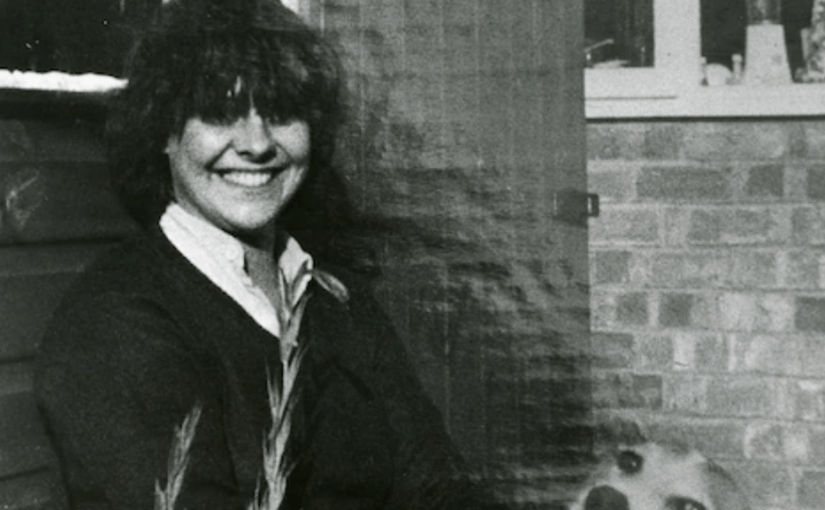
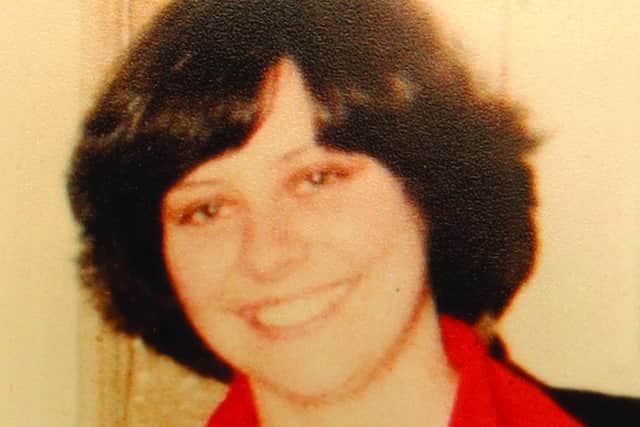
In the early hours of Sunday 2nd September 1979, 20-year-old student Barbara Leach, pictured, was brutally murdered and dumped in a Bradford alleyway by Peter Sutcliffe. By now, Sutcliffe had eluded capture since his first officially acknowledged victim, Wilma McCann, in 1975.
Barbara was originally from Kettering in Northants, and was in her third year at Bradford Uni studying humanities and economics. On the previous Saturday, she had been enjoying a night out with friends at The Manville Arms pub in Great Horton Road, Bradford. Come closing time she fancied a walk home, and was never seen alive again.
She was found on Monday 3rd September; her body had been stuffed under an old carpet at the back of residential houses in Ash Grove. She had been struck on the back of the head with a hammer, and repeatedly stabbed in the chest and abdomen.
The Senior Investigating Officer at the scene was Detective Chief Superintendent Peter Gilrain of Bradford Area Police.
A reporter was questioning Gilrain on camera, about whether he thought this might be part of the linked series of attacks in the area. The reporter asked, Were you prepared for this? Gilrain’s reply stopped me in my tracks.
The Words
odd /ɒd/ adjective: infrequent; occasional; spare; isolated; random
Use odd before a noun to indicate that you are not mentioning the type, size, or quality of something because it is not important
Even at the most basic level, Gilrain’s statement is highly offensive. Where is his sense of urgency? Or his consideration for the young woman lying in the alleyway? His response is the verbal equivalent of him shrugging his shoulders. Someone in Gilrain’s position is not deserving of leniency when being so publicly flippant about the murder of a young woman. His response may have been brief, but it reveals a shocking amount, for which he should be held accountable.
It could possibly be suggested that he had been put on the spot by the interview, and wasn’t given time to consider a prepared statement. I’ll concede that Gilrain was apparently a quiet man and not a lover of the spotlight, so yes, there may have been some nerves at play. But could that not lead us to argue that the spontaneity of it makes it even more likely that he answered honestly? It was literally the first thing that came into his head, having had no time to plan. To me, that’s revealing.
To reiterate; the definition of odd, when used as an adjective in this context, is: infrequent; occasional; spare; isolated; random.
Well, of course, we can’t cater for the killing of the odd female, at any time.
His insinuation is that the women being attacked are at best random, and that the force couldn’t possibly be expected to spend time and resources being ‘prepared’.
Let’s drill down:
To start with, his use of ‘of course’ is worthy of note. He begins by emphasising what he believes to be an obvious point. Collins Online Dictionary states, that the adverb ‘of course’, is used to suggest that something is normal, obvious, or well known, and should therefore not be a surprise to the person you are telling. In other words, Gilrain is subtly berating the reporter for this line of questioning. In Gilrain’s opinion, it’s obvious that they could NOT have possibly been prepared when the attacks are in fact just random. In effect, that very swift ‘of course‘ serves, in Gilrain’s mind, to exonerate the force of that particular responsibility.
Then we have ‘cater’. When used in this context, it usually suggests someone or something is being asked to do something unreasonable. i.e., expectations can’t be met: “Our venue couldn’t cater for the crowds”; “the bookshelf couldn’t cater for the weight”. Gilrain is suggesting that the police shouldn’t even be expected to handle murders at the rate at which they were happening, whilst simultaneously playing down the number of murders with his use of the word ‘odd’. A clear and clumsy self-contradiction. Not only does his calamitous word choice expose his attitude toward the victims, it also reveals something so ingrained within this case from day one, that it almost became a trademark. By suggesting that these attacks are odd, or random, confirms that police saw each attack not as one of a group, but as isolated incidents, and therefore … What? Less worrying?
Moreover, this suggestion comes despite the fact that the killer’s MO across the board, is clear for everyone to see. Yet, the police narrative was that he only killed prostitutes, which arguably prevented them from opening their eyes when women who weren’t prostitutes were attacked. We don’t even need the benefit of hindsight here – the evidence was quite literally laid bare, yet still they failed to join the dots.
Finally, he closes with ‘at any time’, which strikes me as clunky diction, when more commonly one would say, ‘at any particular time’, or ‘at any given time’. Either way, what he’s suggesting is that these attacks can happen at a moment’s notice, any time of day or night. So again, we need to drill. He’s peddling that idea of ‘random’ again: any time – unexpectedly – out of nowhere.
But had they LINKED the attacks, they would indeed have seen the pattern. Sutcliffe typically struck late in the evening, into the early hours of the following morning. Often at a weekend, but in fairness the ratio of weekend to weekday probably isn’t compelling enough to constitute a pattern. However, Barbara’s was the eighteenth attack overall. Eighteen women, all of whom were alone and killed or attacked at night, within a short distance from each other, all by a perpetrator using virtually the same MO at every scene. I’m struggling to see the randomness of any of this.
How many does it take?
You’ve read my thoughts and suggestions above, now it’s time for some facts. And once you’re furnished with these, you’ll understand why Peter Gilrain’s statement is so deserving of your contempt.
First, let’s look only at the ‘official’ Sutcliffe attacks, i.e., the ones included in the linked series, to which Sutcliffe later confessed and was convicted for. Had these been the only attacks, Barbara would have been the sixth woman to be attacked and the third to die in Bradford, since 1975. Six attacks, resulting in three deaths, in Bradford alone.
Now, let’s include the unacknowledged attacks, i.e., the ones not included by police in the linked series, but nevertheless, thought by many forensic and criminal experts, to be the work of Sutcliffe. (Note: these experts included the pathologist who had worked closely on the case from the start, and a police officer who in 1982, went on to conduct a dedicated review of these unlinked attacks.) When we include these, the figures become completely confounding:
Between 1966 and 1979 there were fourteen attacks in the Bradford area alone. FOURTEEN. Nine surviving victims, and five deaths; Barbara being the fifth.
The very nerve of that reporter for suggesting they should be prepared.
So now you know the numbers, tell me, how does any of that constitute ‘the odd female’? Regardless of which set of figures you hang your hat on, there’s a pattern, right? There was nothing odd, or random, or isolated about these attacks – absolutely nothing. And if Gilrain, a senior officer, was using language like that on national TV, what was going on behind closed doors? What hope did they have of catching Sutcliffe with that attitude? What chance was there for any respect or dignity for the victims, or empathy for their families?
Gilrain was the face of the force at that precise moment. Barbara Leach’s poor parents would most likely have seen that TV report. At best, it was insensitive and unforgivable. At worst, it exposed those who should have been protecting women, as dismissive, indifferent, and lacking in even the tiniest amount of consideration for those most affected by what was happening. This rhetoric is nothing short of dangerous and will be a recurring theme across later blogs.
‘The odd female’ really didn’t stand a chance, did she?

