
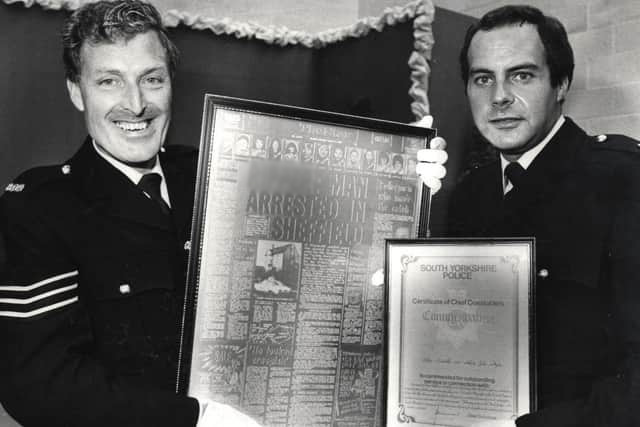
On 2nd January 1981, Peter Sutcliffe was apprehended in Sheffield. The arresting officers had no prior involvement in the case, but their instincts and integrity brought the biggest murder hunt in British criminal history to its final conclusion.
In this special anniversary blog, we take a break from the usual linguistic analysis, to celebrate Sergeant Robert Ring and Probationer-Constable Robert Hydes. Two undisputed heroes who remained humble, professional, and respectful from the moment they realised what they were on to; uninterested in the glory so publicly craved by lesser men in the higher ranks.
So surreal and convoluted were the events that unfolded, you’d be forgiven for not believing they really happened. Much has been written over the years, and in their entirety the details are hard to follow and completely mind-boggling. So I’ve summarised that historic night, and the days that followed, into a digestible blog, which I hope engages you for long enough that you might finally feel something positive towards this case. Here’s to the men who followed their gut, joined the dots, and got the job done.
A night like any other
At Hammerton Road police station in Sheffield, South Yorkshire, Sergeant Robert Ring was about to go out on a routine drive-by of the local red light area. Bob Ring was 47, and the father of two teenage kids. He had joined the force aged 21, after finishing his National Service.
His colleague, PC Robert Hydes, was 31 and a probationer, who, less than a year before, had left his job as an engineer, for a new career in the police force. He had been at Hammerton Road for around seven months. Bob Ring realised Hydes had never been out on a routine vice run, so invited him along.
At around 10.50pm, the two officers spotted a car parked in Melbourne Avenue, in the Broomhall area of Sheffield. It was facing the road with its headlights full on. Bob Ring found this unusual, as ‘punters’ usually took more care not to be seen. He decided to check it out, and pulled up at the end of the road.
The vehicle was a large brown Rover 3500 saloon with a black vinyl roof. Inside, sat a dark-haired, bearded man, and a woman who appeared to be a prostitute. When the driver was questioned, he claimed that the woman was his girlfriend, and gave a false name and address. Hydes returned to the police car, and called in the vehicle details for a PNC check. The vehicle details on the system didn’t match the Rover – and the pair were arrested on suspicion of car theft. On exiting the car, the driver claimed he needed to urinate, and was allowed to go around the corner behind an old storage tank.
Back at Hammerton Road, the pair underwent questioning, with two additional anti-vice officers present. One of them, Sergeant Arthur Armitage, went to another office to file a document, where he saw an old photofit of the YR on the wall, and clocked its resemblance to the man they held next door. He returned to the interview room and made a semi-flippant remark that Sutcliffe could be the YR. Sutcliffe, who had still not disclosed his real name and address, said nothing.
With his suspicion aroused, Armitage returned to the vehicle in Melbourne Avenue, where he discovered stolen plates had been taped over the originals. With the genuine plates now revealed, he found out that the registered keeper was one Peter William Sutcliffe of 6 Garden Lane, Bradford. With his details now exposed, Sutcliffe admitted to stealing the plates from a local scrapyard.

At this point, Sutcliffe could have been charged and bailed, but following a quick briefing, everyone decided their man was ‘iffy’. His stories had changed, he’d lied about using prostitutes, and something about him just didn’t add up. They decided to hold onto him for a while longer.
By now, the Rover was back at the station, and Sgt Ring took Sutcliffe down to look at it. He wanted Sutcliffe to talk him through the tools that were in the boot. Ring recognised one particular tool, and knew it should typically be accompanied by a hammer. This one wasn’t, so Ring asked Sutcliffe where the hammer was. Sutcliffe denied ever having it.
Back in the interview room, Sutcliffe was asked if he’d ever been questioned by the R Squad. He said yes, and that ‘everyone had’. At this point, he became noticeably uncomfortable, shifting in his seat and avoiding eye contact.
As a precautionary measure, at around 1am on Saturday 3rd January, Bob Ring called the incident room at Millgarth, to cross-check Sutcliffe. Eventually, Sgt Rob Bennett at Millgarth retrieved all the index cards relating to Sutcliffe, and became concerned at some of the comments made on the cards by interviewing officers at the time. They had noted how they weren’t happy with Sutcliffe but that their concerns had been dismissed. Bennett also noted that Sutcliffe was a lorry driver, had a gap in his teeth, had previously lied about using prostitutes, and that most of his alibis for the dates of the murders, had been provided by his wife. He had eventually been eliminated after the hoax letters in 1979, because his handwriting didn’t match. Bennett found all of these details too hard to ignore, so he initiated a discussion with his colleagues at Millgarth.
Now, here’s where it gets complicated because a third force comes into play. The stolen plates occurred in Dewsbury, so the Dewsbury force were invited to collect Sutcliffe, and take him back to their station for charging. He was held there for a number of hours, during which time, Sgt Bob Ring from Sheffield knocked off duty, went home, and endured an uneasy night as the day’s events played on a loop around his head. He knew things weren’t right.
Closing in
Also during this time, DS Desmond Finbarr O’Boyle from Dewsbury, had made the trip over to Millgarth, to read up on everything they had pertaining to Sutcliffe. O’Boyle was 35 and highly experienced – he genned up, then returned to Dewsbury to question Sutcliffe further. Questioning ended around 10pm.
Sgt Bob Ring returned to duty in Sheffield the next morning, only to be told that Sutcliffe was still being held at Dewsbury. This was enough to make Bob act on his instincts. Something had been bothering him since his initial meeting with Sutcliffe in Melbourne Avenue. Ring returned to the scene, and approached the storage tank where he had allowed Sutcliffe to go to the toilet. Beneath a pile of wet leaves, he found a ball peen hammer.
Perfect policing
Ring called the hammer in, at which point, PC Hydes was walking the beat close by. Hydes received a call to join Ring at Melbourne Avenue, where a further search also revealed a discarded knife. They called the new find in to Hammerton Road, who then called it in to Millgarth. By now, it was the early hours of Sunday 4th January, and DI John Boyle had come on duty at Millgarth. Apologies here – the following names don’t make life easier when trying to follow the chain of events: DI Boyle at Millgarth called DS O’Boyle at Dewsbury, to ask if Sutcliffe was still there being questioned about the number plates. O’Boyle confirmed he was, and Boyle told him about the hammer and the knife.
“Bingo!” shouted O’Boyle. “We’ve got him!“
Not only had they got him, but officers Ring and Hydes had also, unknowingly, saved the life of Olivia Reivers – the woman they’d found in the car with Sutcliffe, who was, no doubt, his next intended victim.
End of the road
The questioning had continued at Dewsbury for hours, when a flagging Sutcliffe said he felt as if the officers were leading up to asking him about the YR.
An officer asked, “What about the YR?”
To which Sutcliffe replied, “Well, it’s me.”
His confession lasted 15 hours, and he was formally charged on Monday 5th January at Dewsbury Magistrates Court.
Senior officers jeopardise trial
Chief Constable Ron Gregory wasted no time in rallying the press. Along with ACC George Oldfield and DCS Jim Hobson, he called a press conference at 9pm on the Sunday, where they performed like grinning school boys. Whilst he did acknowledge the two officers involved in Sutcliffe’s arrest, the conference served as an overt backslapping opportunity with sinister connotations, of which Gregory seemed completely oblivious. So, although I had intended this blog to shine a much-deserved spotlight on officers Ring and Hydes (may you always remember their names), I can’t finish without drawing attention to what happened next.
Keep in mind that Sutcliffe had not, at this point, been charged; he was in police custody for questioning. Gregory, however, proceeded to insinuate that they had caught the YR, and that the investigation would be scaled down with immediate effect. So completely unable was he to keep his own euphoria in check, Gregory’s loose lips came perilously close to jeopardising any upcoming trial by more or less accusing their suspect of being guilty, live on TV. This could have potentially made a fair trial virtually impossible, risking the case being thrown out, and Sutcliffe walking free.
The sickening charade was thoroughly disrespectful of the victims and their families.

And there’s one more disturbing fact worthy of note. At the conference, Gregory is asked whether the suspect had a Geordie accent. He replied, “I cannot tell you that because I have not heard him speak”. This is untrue and is simply Gregory’s attempt at avoiding the very obvious embarrassment of how wrong they were about the hoaxer (see point 7 of the Case Notes page for more on this).
In fact, during an interview for the Mail Online in November 2023, PC Robert Hydes (now 74) broke his silence on the case, out of sheer frustration at constantly seeing misreports in the press. Hydes claims that when they made the initial call to Millgarth, no one there was interested in their suspicions surrounding Sutcliffe … because he didn’t have a Geordie accent. Hydes says it took five phone calls, ending in one from a senior officer at Hammerton Road, before Millgarth would take them seriously.
Gregory was, of course, fully aware that the man in custody did not have a Geordie accent.
The Press Council
In 1983, The Press Council (which was replaced in 1991 by the Independent Press Complaints Commission), undertook a significant investigation into the conduct of the press during the Peter Sutcliffe case. On page 33 of the report, they noted that in late January 1981, the Guardian had run a cartoon of a police helicopter attempting to land in the Arctic, with one local saying to another, “They’re looking for an impartial jury.” The potential damage being posed by Gregory’s media circus was lost on no one, other than Gregory, it seemed.
Such was the threat he had placed the case under, that the matter came up during discussions about amendments to the Contempt of Court Bill in the House of Lords on 20th January 1981. The Lord Chancellor at the time, Lord Hailsham, commented:
Policemen must remember that they must obey the law no less than editors. If editors are provoked by policemen, to break the law, I know who is most to blame.
Can you imagine what would have happened if – after everything officers Ring and Hydes had done, and everything the officers and staff at Millgarth had been through – it had been the actions of a senior officer that had finally allowed Sutcliffe to walk free? It came so close; but no doubt Gregory would have deflected with yet another flippant wisecrack, and then gone about his business, looking forward to his nice fat pension.
But, so as not to sour what is meant to be the positive study of two hard-working Bobbies, let’s finish with this: Sgt Robert Ring and PC Robert Hydes, pictured together after the arrest, forty-four years ago today.
On behalf of women everywhere, Lads, thank you.


